Common Structured Cabling Mistakes and How to Avoid Them
The structured cabling mistakes that cause outages and failed handovers in Dubai projects, plus practical, field-tested ways to avoid every one of them.
The short answer: most structured cabling problems come from a handful of avoidable mistakes, namely poor planning, exceeding length limits, sloppy terminations, ignoring cable management and skipping certification. Each is cheap to prevent and expensive to fix once the building is occupied.
Cabling faults are uniquely frustrating because they are hidden, intermittent and disruptive to repair. The good news is that the common failures are well understood. Here are the mistakes we see most often in Dubai projects, and how to design them out.
Mistake 1: Skipping the Plan
Cabling installed without a structured design becomes an unmanageable tangle. There is no logical numbering, no documentation and no consistency, so every future change is guesswork.
How to avoid it: start with a proper design that defines pathways, outlet counts, labelling conventions and equipment room layouts before any cable is pulled. A plan that fits on paper saves days of confusion on site.
Mistake 2: Exceeding Length Limits
Copper twisted-pair channels have a maximum length, commonly cited as around 100 metres including patch cords. Runs that exceed it produce flaky links that pass casual checks but fail under load.
How to avoid it: measure real-world routes, not straight-line distances, and place floor distributors so no horizontal run is over-stretched. For longer distances, switch to fiber.
Mistake 3: Poor Terminations
A great cable ruined by a bad termination is one of the most common faults. Untwisting pairs too far, loose connectors and rushed crimping all degrade performance.
How to avoid it: use trained installers, follow the connector manufacturer's method, and keep pair untwisting to the minimum. Quality terminations are a discipline, not a luxury.
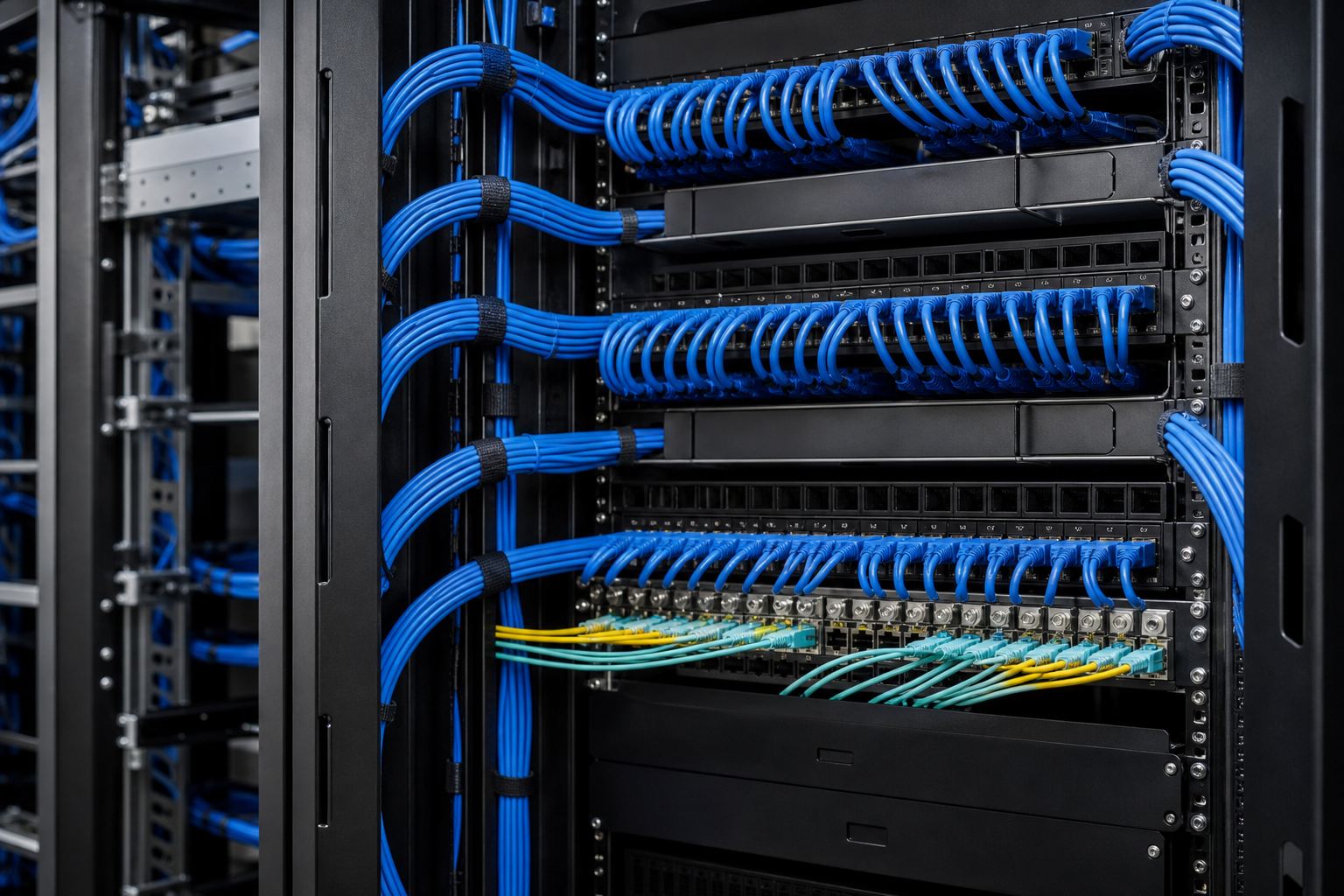
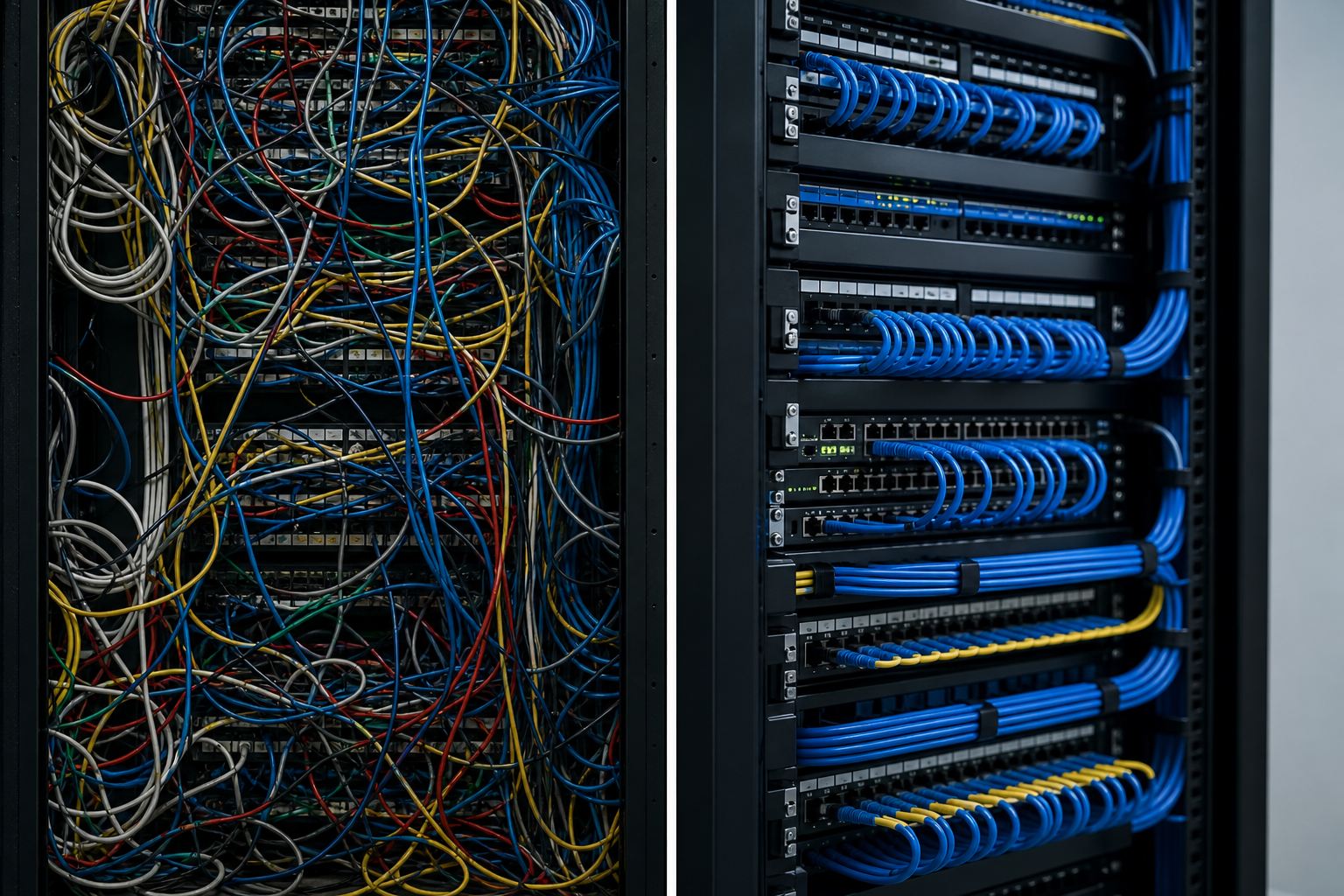
Mistake 4: Ignoring Cable Management
Bundles crammed into trays, tight bends and unlabelled cables look harmless on day one and cause chaos for years.
| Bad practice | Consequence | Better approach |
|---|---|---|
| Cables zip-tied too tight | Crushed conductors, degraded signal | Loose, supported bundles |
| Sharp bends at panels | Performance loss | Respect bend radius |
| No labels | Slow fault-finding | Label both ends, consistently |
| Overfilled trays | Heat, future access blocked | Leave spare capacity |
How to avoid it: treat tidy, labelled, well-supported cabling as a deliverable in its own right. It pays back at every future moves-adds-and-changes job.
Mistake 5: Running Data Too Close to Power
Data cabling routed alongside power can pick up electrical interference, especially over longer parallel runs, leading to errors and reduced throughput.
How to avoid it: maintain proper separation between power and data pathways, and cross at right angles where they must meet. This is a basic rule that is surprisingly often broken on busy sites.
Mistake 6: Using the Wrong Grade of Cable
Specifying a low grade to save money, or mixing grades inconsistently, caps performance and shortens the system's useful life.
How to avoid it: choose a standard with headroom for future needs, typically a 10 Gigabit-capable copper grade plus quality fiber backbones, and apply it consistently across the building.
Mistake 7: Skipping Certification
Some installations are signed off on a quick continuity check rather than full certification. Defects then surface later as live outages.
How to avoid it: insist on certification testing for every link, with results documented and handed over. It is the only objective proof that the cabling meets its standard.
Mistake 8: Forgetting Operator and Approval Requirements
In the UAE, cabling and pathways must align with the requirements of operators such as DU and Etisalat. Ignoring this until handover invites rejection and delay.
How to avoid it: confirm the serving operator and their standards at design stage, and keep documentation in the expected format. Build to the approval, not around it.
The Common Thread
Almost every mistake here shares one root cause: treating cabling as a commodity to be rushed rather than an engineered system to be designed, installed and verified. The difference between a problem-free network and years of intermittent faults is rarely the cable itself; it is the care taken around it.
Our team designs, installs and certifies structured cabling to avoid exactly these pitfalls. Learn more about our services or review delivered work in our projects.
If you are planning an installation, or inheriting one you are not sure about, contact our team for an assessment. Catching these mistakes on paper is always cheaper than fixing them in a live building.
Frequently asked questions
What is the most common structured cabling mistake?+
Poor planning and documentation. Many problems trace back to cabling that was installed without an organised design or accurate labelling, which turns every later fault into a slow, costly investigation.
Why does cable length matter so much?+
Copper structured cabling has a fixed channel length limit, around 100 metres. Exceeding it causes intermittent, hard-to-diagnose faults, so runs must be planned and measured to stay within the standard.
Do I really need to certify the cabling?+
Yes. Certification testing proves each link meets its performance standard and gives you a documented baseline. Skipping it means defects surface later as live faults rather than being caught at handover.
Can power cables run alongside data cables?+
They should be kept separated. Running data cabling too close to power can introduce electrical interference and degrade performance. Maintaining proper separation is a basic but frequently ignored requirement.