
Public Address & Voice Alarm Systems: Compliance in the UAE
How public address and voice alarm (PA/VA) systems work, where they are required, and what compliance typically involves for buildings in Dubai and the UAE.
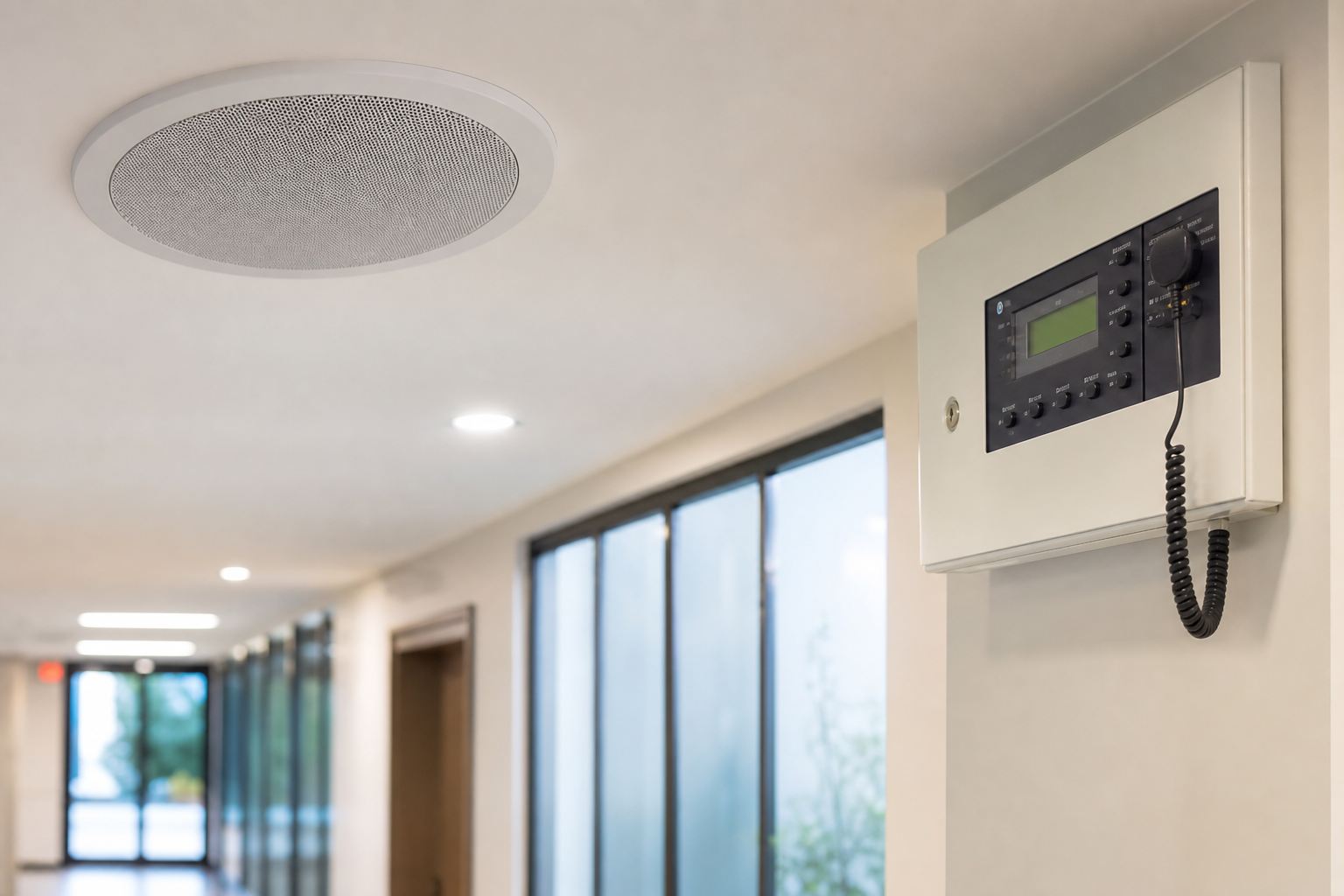
A public address and voice alarm (PA/VA) system broadcasts both everyday announcements and life-safety evacuation messages through one integrated network of speakers and amplifiers. In the UAE, voice alarm is generally a life-safety system that must give the spoken evacuation message priority over all other audio, and it is typically required in larger or higher-risk buildings.
What PA/VA Systems Actually Do
A combined system serves two purposes from shared infrastructure:
- Public address (PA): routine paging, zone announcements, background music feeds and operational messages.
- Voice alarm (VA): clear, pre-recorded or live spoken instructions during a fire or emergency, replacing or supplementing simple sounders.
The key principle is priority. When the fire alarm panel signals an evacuation, the voice alarm overrides music, paging and any other audio so occupants receive a single, unambiguous instruction. This matters because people respond far faster and more calmly to a clear spoken message than to a generic tone.
Where Voice Alarm Is Typically Required
Requirements depend on occupancy type, building height and complexity. As a general guide, voice alarm is commonly expected in:
| Building type | Why VA is usually expected |
|---|---|
| Malls and large retail | High, transient occupancy unfamiliar with exits |
| Hotels and serviced apartments | Sleeping risk and multilingual guests |
| Hospitals and clinics | Phased or staged evacuation needs |
| High-rise towers | Complex evacuation and refuge strategies |
| Transport and assembly venues | Very large crowds and noise |
Smaller or lower-risk buildings may be served adequately by conventional sounders. Because thresholds change, you should always confirm current requirements with Civil Defence and your fire consultant rather than assuming.
Compliance in the UAE
Life-safety systems in the UAE generally fall under Dubai Civil Defence or the equivalent authority in each emirate. In practice, compliance typically involves:
Design and approval
The system design is usually prepared by an approved consultant, submitted for review, and installed by an approved contractor. Equipment generally needs to be listed or approved to recognised standards.
Integration with fire detection
The voice alarm must interface with the fire alarm and detection system so that the correct zones are triggered automatically. Phased evacuation strategies in tall buildings depend on this coordination.
Speech intelligibility
A voice alarm is only useful if people can understand it. Designers typically assess speech intelligibility (often using a metric such as STI) across the covered area. Good intelligibility comes from correct speaker selection, spacing and tuning, not simply turning up the volume in reverberant spaces such as atriums or car parks.
Resilience and monitoring
Systems are usually designed with monitored circuits, standby power and fault reporting so that a single failure does not silence a zone. Battery backup and supervised cabling are common expectations.
Designing for Real Buildings
A few practical points make the difference between a system that passes inspection and one that genuinely performs:
- Zone the building logically. Align audio zones with fire zones and evacuation strategy so messages reach exactly the right areas.
- Match speakers to the space. Open lobbies, plant rooms, guest rooms and car parks each need different speaker types and densities.
- Plan for languages. In Dubai's multilingual environment, pre-recorded messages are often provided in more than one language.
- Document everything. Cause-and-effect matrices, as-built drawings and commissioning records support handover and future maintenance.
For a wider view of how PA/VA fits alongside fire detection, networks and AV, see our services, and you can review completed installations through our projects.
Testing, Handover and Maintenance
Commissioning typically includes verifying every zone, confirming priority over PA and music, checking intelligibility, and proving standby power. After handover, periodic testing and maintenance keep the system compliant and reliable. Keeping records of these tests is important both for safety and for any future authority inspection.
A well-designed PA/VA system should be largely invisible day to day, handling routine announcements quietly, then becoming the clearest voice in the building the moment an emergency occurs.
Talk to Us About Your Building
Every building has a different occupancy, layout and evacuation strategy, so PA/VA design is rarely one-size-fits-all. If you are planning a new fit-out, an upgrade or a compliance review, contact our team to discuss a system tailored to your site and current UAE requirements.
Frequently asked questions
What is the difference between PA and voice alarm?+
Public address (PA) handles everyday announcements and background paging, while voice alarm (VA) is a life-safety system that broadcasts intelligible evacuation messages during a fire. A combined PA/VA system shares speakers and amplifiers but gives the voice alarm function absolute priority over all other audio.
Is a voice alarm system mandatory in Dubai?+
Voice alarm is typically required in larger, higher-occupancy or complex buildings such as malls, hotels, hospitals and high-rise towers, where a simple sounder would not give clear evacuation guidance. Always confirm current requirements with Civil Defence and your fire consultant for your specific occupancy and building height.
Who approves a voice alarm system in the UAE?+
Life-safety systems generally fall under Dubai Civil Defence (or the relevant emirate's authority), and design, equipment and installation typically need approval through an approved consultant and contractor. Check current submission and certification requirements before procurement.
What does speech intelligibility mean for VA?+
Speech intelligibility is a measure of how clearly evacuation messages can be understood at every point in the building. It is usually assessed against a recognised metric (such as STI) and depends on speaker placement, acoustics and amplifier design rather than just volume.